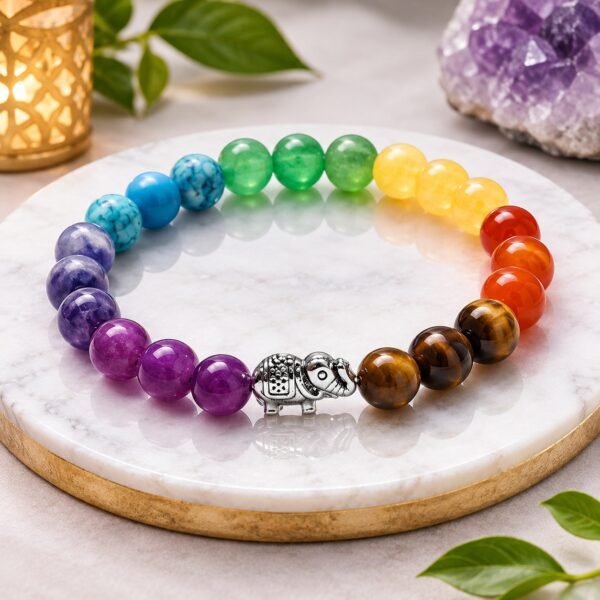
Agate is one of the oldest stones people have worked with. Beads from the Indus Valley, made in Gujarat more than 4,000 years ago, are agate. Its stripes and swirls come in endless patterns, and crystal users value it as a steady, balancing stone.
What is agate?
Agate is banded chalcedony, a form of quartz made of microscopic crystals. It forms when silica-rich water seeps into gas pockets in volcanic rock and deposits layer after layer over long periods. Tiny changes in the water create the bands.
The name comes from the Achates river in Sicily, where the Greeks found it. In India agate is known as akik, and craftspeople in Khambhat (Cambay), Gujarat, have been cutting and polishing it for millennia. India, Brazil, Uruguay, Botswana and Mexico are all major sources today.
Popular types of agate
- Blue lace agate: soft blue and white bands, for calm communication
- Botswana agate: fine grey, pink and peach bands
- Crazy lace agate: wild swirls of red, cream and yellow from Mexico
- Moss and tree agate: chalcedony with plant-like inclusions (technically not banded)
- Fire agate: brown agate with iridescent flashes
- Dendritic agate: fern-like black markings
Each of these has its own guide on ShivaCrystals.
Agate meaning and traditional uses
- Balance: steadying emotions and energy
- Stability: a slow, grounding stone, not a quick fix
- Protection: agate amulets were carried in ancient Egypt, Persia and India
- Confidence: said to build calm self-assurance over time
In Islamic and South Asian traditions, akik rings, often red or brown agate engraved with prayers, are worn for blessings and protection. It’s linked with the root chakra and with Gemini.
How to use agate
- Wear an agate ring, bracelet or pendant. It’s tough enough for daily wear.
- Keep agate slices on a windowsill or desk. Light shining through shows the bands beautifully.
- Use agate coasters, bookends and bowls as everyday reminders of balance.
- Hold a tumbled stone in stressful moments.
Cleansing and care
Agate is hard and water-safe. Clean it with warm soapy water and a soft brush. Sunlight and moonlight are fine for natural agate, but brightly dyed agate can fade in strong sun.
Buying guide and price
- Agate is affordable, especially in India.
- Crisp, fine, colourful banding is most valued.
- Natural colours are greys, whites, browns, reds, oranges and soft blues.
- Large geodes and slices with unusual patterns are collectible.
Dyed agate: what to watch for
Agate is porous and takes dye easily. Very bright pink, purple, teal, green and electric blue agate slices are almost always dyed. Dyed agate is fine to buy if it’s labelled honestly. Look for colour pooling in cracks and unnatural, even saturation.
Crystals that pair well with agate
Carnelian (closely related chalcedony), moss agate, blue lace agate and black tourmaline for grounding.
Frequently asked questions
Is agate a crystal?
It’s microcrystalline quartz, made of crystals too small to see.
Is akik the same as agate?
Yes. Akik is the Hindi, Urdu and Arabic name for agate.
Can agate go in water?
Yes. It’s water-safe.