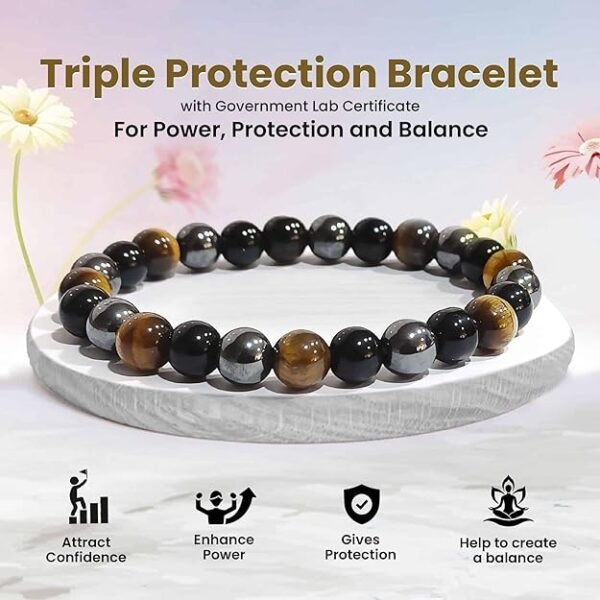
Obsidian is glass made by a volcano. It’s smooth, glossy and usually black, and it breaks into edges sharper than steel. In crystal practice it’s one of the best-known stones for protection, honesty and grounding.
What is obsidian?
Obsidian forms when silica-rich lava cools so quickly that crystals don’t have time to grow. The result is a natural glass, not a mineral with a crystal structure. Its black colour comes mostly from tiny particles of magnetite and other iron minerals. Small inclusions, bubbles and mineral growths create the many varieties: snowflake, mahogany, rainbow, golden sheen and silver sheen.
Obsidian is found wherever there has been the right kind of volcanic activity: Mexico, the western USA, Armenia, Iceland, Turkey, Italy, Japan and Ethiopia. Over thousands of years it slowly turns cloudy and crystallises, so most obsidian is geologically young, typically less than 20 million years old.
Obsidian in history
For early humans, obsidian was one of the most valuable materials on Earth. It was knapped into blades, arrowheads and scrapers, and it was traded hundreds of kilometres from its sources. The Aztecs and Maya used it for tools, weapons and polished mirrors. Today, some surgeons have used obsidian scalpel blades for very fine cuts, because a fractured edge can be just a few nanometres thick.
Obsidian meaning and traditional uses
- Protection: traditionally seen as a shield against negativity
- Truth: a “mirror” stone that encourages honest self-reflection
- Grounding: a root chakra stone for steadiness
- Letting go: used when working through grief, anger or old patterns
It’s associated with Scorpio, Sagittarius and Capricorn.
Types of obsidian
- Black obsidian: the classic, glossy black form
- Snowflake obsidian: white cristobalite “flowers”
- Mahogany obsidian: red-brown swirls from iron oxide
- Rainbow obsidian: hidden bands of colour
- Golden sheen and silver sheen obsidian: a metallic glow from gas bubbles
- Apache tears: small, rounded nodules
Who obsidian suits
- people who feel drained by crowded or stressful places
- anyone working on honest self-reflection, in journalling or therapy
- those who want a strong, simple protective stone for the home
Where to place obsidian
- near the front door, as a protective stone
- beside a computer or TV, a popular modern habit
- in a quiet corner used for reflection or prayer
Cleansing and care
Obsidian is water-safe, but it’s glass: it chips and can crack if dropped or heated suddenly. Rinse it in lukewarm water and dry it with a soft cloth. Handle broken pieces carefully, because the edges are extremely sharp.
Real or fake obsidian?
- Black glass is the most common imitation.
- Man-made glass often has round bubbles and looks completely uniform.
- Real obsidian may show flow lines, fine inclusions or a faint sheen in strong light.
- Bright blue, green or purple “obsidian” is almost always man-made glass.
Crystals that pair well with obsidian
Black tourmaline, smoky quartz, hematite and selenite for balance.
Frequently asked questions
Is obsidian a crystal?
Not strictly. It’s volcanic glass with no crystal structure, but it’s widely used in crystal practice.
Can obsidian go in water?
Yes, briefly. Dry it afterwards.