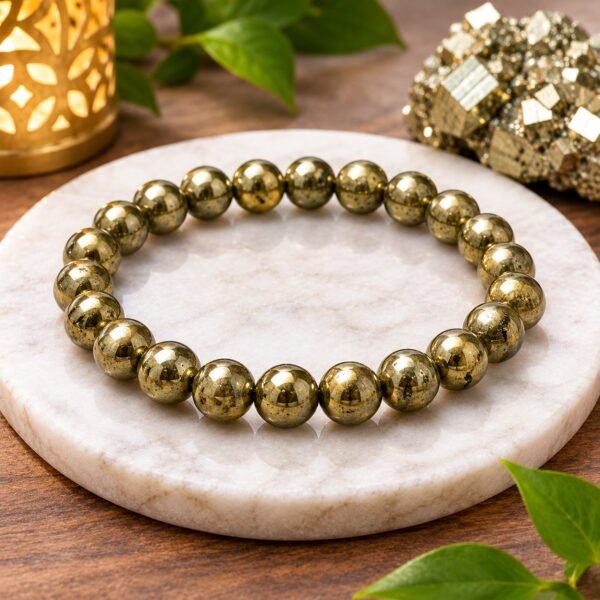
Gold needs little introduction. It’s been treasured for over 6,000 years, and it has a special place in Indian life, from weddings and festivals to temple offerings. In crystal practice, natural gold is linked with prosperity, confidence and purity.
What is gold?
Gold is element 79, a soft, dense, yellow metal that doesn’t rust or tarnish. It’s found as nuggets, flakes and grains in rivers (placer gold), and in quartz veins deep underground. Natural gold specimens in quartz, or as crystals and leaf-like growths, are prized by mineral collectors.
Pure gold is very soft, so jewellery mixes it with other metals. Purity is measured in karats:
- 24K: 99.9% gold, used for coins and bars
- 22K: 91.6% gold, the traditional choice for Indian jewellery
- 18K: 75% gold, often used for diamond and gem settings
- 14K: 58.5% gold, common in Western jewellery
Gold in Indian tradition
Gold is linked with Lakshmi, the goddess of wealth, and is bought on auspicious days such as Akshaya Tritiya and Dhanteras. It’s central to weddings, gifted as stridhan, and offered in temples. In Vedic astrology, gold is the metal of Surya (Sun) and Guru (Jupiter), and gems such as ruby, yellow sapphire and red coral are traditionally set in gold. India’s only major working gold mine is at Hutti in Karnataka.
Gold meaning and traditional uses
- Prosperity: wealth, security and abundance
- Confidence: a solar plexus metal
- Purity: because it doesn’t tarnish
- Love and commitment: wedding rings and mangalsutras
- Amplification: believed to strengthen the gems set in it
It’s associated with Leo.
Who gold suits
- people marking milestones: weddings, births and anniversaries
- those setting jyotish gems as advised
- collectors of natural gold specimens
Buying gold in India: BIS hallmark
Since 2021, gold jewellery sold in India must carry a BIS hallmark. Look for:
- the BIS logo
- the purity grade (for example 22K916)
- a six-digit HUID code, which you can verify in the BIS CARE app
Always ask for a bill that shows weight, purity and making charges separately.
Cleansing and care
- wash gold jewellery in warm water with mild soap and a soft brush
- dry it with a soft cloth
- remove it before swimming in chlorinated water
- store pieces separately to avoid scratches
- natural gold specimens should be handled gently; gold is soft
Buying guide and price
- Gold prices change daily with world markets.
- Jewellery prices include making charges and GST.
- Natural gold nuggets and specimens sell at a premium over metal value.
Real or fake gold?
- Gold-plated, gold-filled and brass items are common.
- Real gold isn’t magnetic and doesn’t tarnish.
- Pyrite (“fool’s gold”) is brassy, brittle and much harder.
- For certainty, buy hallmarked jewellery or have an XRF purity test.
Crystals that pair well with gold
Ruby, yellow sapphire, citrine and pyrite.
Frequently asked questions
What does 916 mean on gold?
It means 91.6% pure gold, which is 22 karat.